The problem
Hadley Bricks buys, sells, and invests in LEGO — retired sets, sealed boxes, loose minifigures, and bulk lots. The business had grown steadily to over 650 active products listed across four different marketplaces: eBay, Amazon, BrickLink, and Brick Owl.
Each platform has its own dashboard, its own fee structure, its own listing format, and its own API quirks. Managing all four from a single spreadsheet had worked well enough at 100 products. At 650, it was becoming a liability.
Three problems were costing the business real money:
Overselling risk. When a set sold on eBay, it could still be showing as available on BrickLink and Amazon. Every oversell meant either cancelling an order — damaging seller metrics — or scrambling to source a replacement at whatever price was available. On platforms like Amazon, where seller performance is tightly monitored, even a handful of cancellations can trigger account restrictions.
Pricing blindness. Prices were set when items were listed and rarely revisited. There was no systematic way to compare what an item was listed at on one platform against what it was actually selling for on another. Market values shift constantly in the LEGO resale world — a set that was £40 six months ago might be £65 today if it's just been retired. Without structured data, these movements were invisible.
Admin overhead. Listing a single product across four platforms meant writing four descriptions, setting four prices, uploading four sets of photos, and maintaining four separate records. Adding a new product to the catalogue took the best part of an hour. Relisting after a sale took nearly as long. Hours every week were going into admin that felt productive but wasn't growing the business.
The solution
We designed and built a custom inventory management system that gives Hadley Bricks a single source of truth for every product, every price, and every listing — with automation handling the repetitive work and AI handling the intelligent work.
Centralised inventory database
Every product lives in one place: a structured database with 45+ tables covering inventory, pricing history, marketplace listings, order tracking, profit margins, and more. When something changes — a sale, a price update, a new listing — it changes everywhere.
The system is built on Next.js and Supabase, running entirely on free-tier cloud infrastructure. For a business with under a thousand products, the compute and storage requirements sit comfortably within free limits.
Monthly infrastructure cost: £0.
AI-powered listing creation
When a new product is added to the system, AI generates an optimised title, a detailed description, and platform-specific formatting — tailored to each marketplace's requirements.
This matters because eBay and Amazon reward very different listing strategies. eBay's Cassini search algorithm favours keyword-rich titles, complete item specifics, and detailed descriptions. Amazon prioritises product identifiers, bullet-point features, and backend search terms. BrickLink buyers expect specific set numbers, piece counts, and condition grading. Writing one listing and copying it across four platforms leaves performance on the table everywhere.
The AI handles all of this. The seller reviews and approves. What used to take 20 minutes per listing per platform now takes two minutes total.
Cost per listing: a few pence.
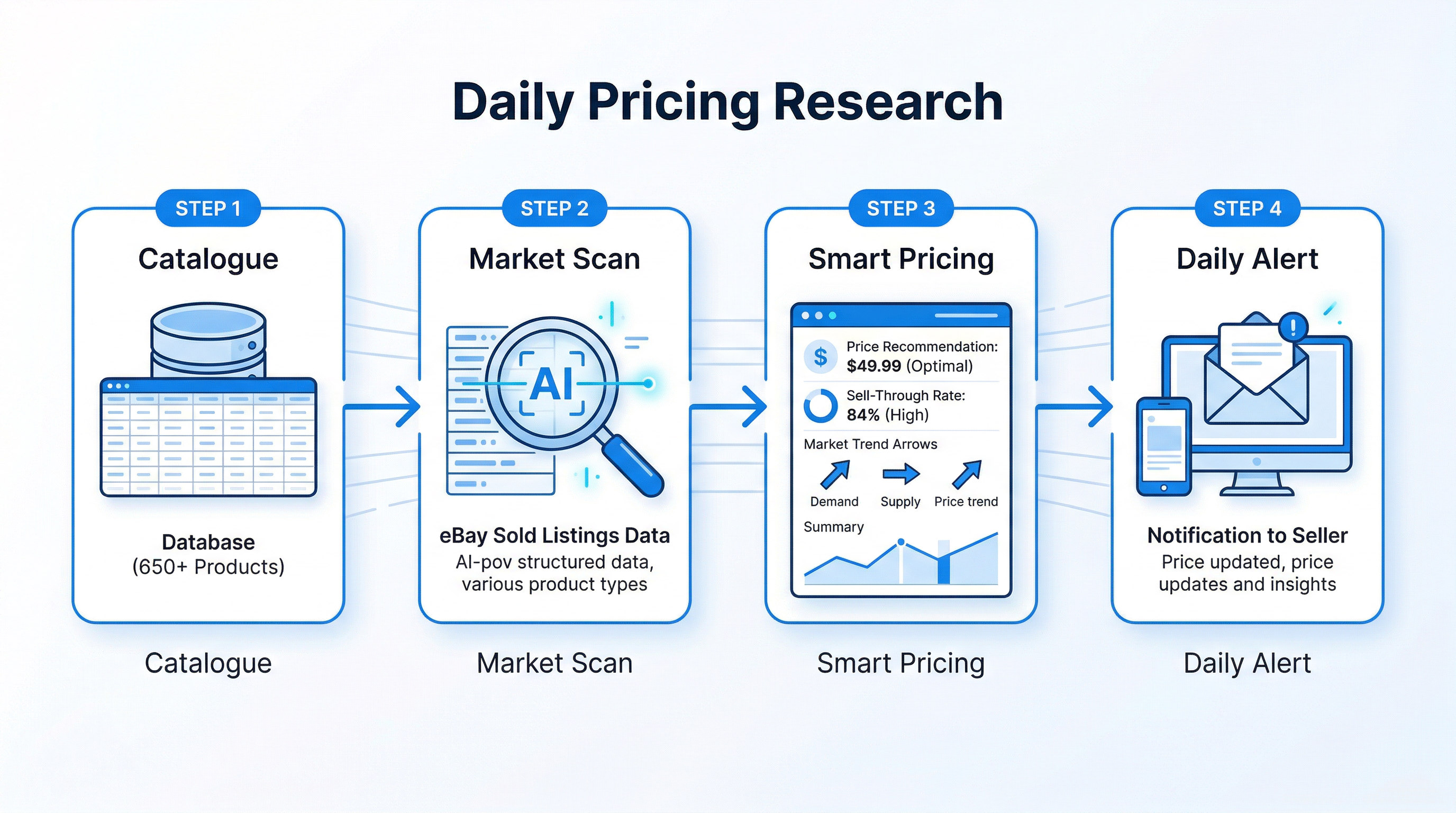
The pricing engine pulls real sold-listing data to ground every price in market evidence.
Automated pricing research
Instead of guessing at prices or manually searching eBay, the system automatically pulls completed sale data — actual transactions, not just asking prices. For every product in the catalogue, it calculates average sold prices, price ranges, sell-through rates, and market velocity.
The output is a clear recommendation: "Price this at £X. Based on recent sales, it should sell within Y days. The market is moving up/down/stable."
This runs daily across the full 650+ item catalogue.
Monthly AI cost for pricing analysis: under £50.
Cross-platform sync and auto-delisting
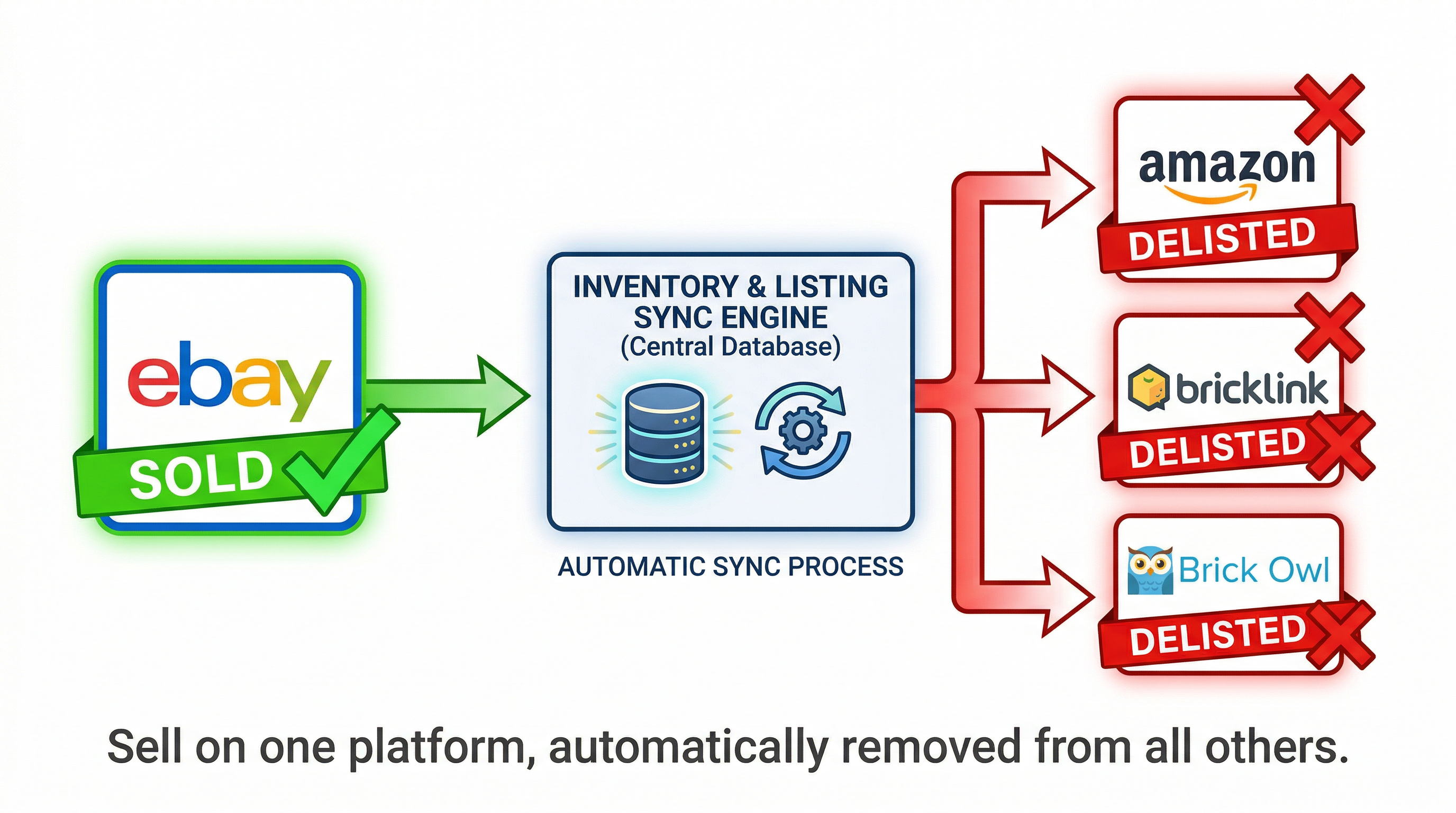
When an item sells on any platform, it's automatically removed from all others — eliminating overselling entirely.
When an item sells on any platform, the system automatically removes or marks it as sold on every other platform. This single feature eliminated overselling entirely.
The sync uses a combination of API webhooks (where platforms support them) and scheduled polling (where they don't). eBay and Amazon provide real-time order notifications. BrickLink and Brick Owl are polled at regular intervals. The result is consistent stock levels across all four marketplaces with no manual intervention.
Daily performance dashboard
Every morning, a summary drops into the inbox: what sold yesterday, current stock levels, total profit margins across all platforms, items flagged for attention, and pricing opportunities the system has identified.
No logging into four separate dashboards. No copying numbers into a spreadsheet. One email, before the first cup of tea.
The cost model
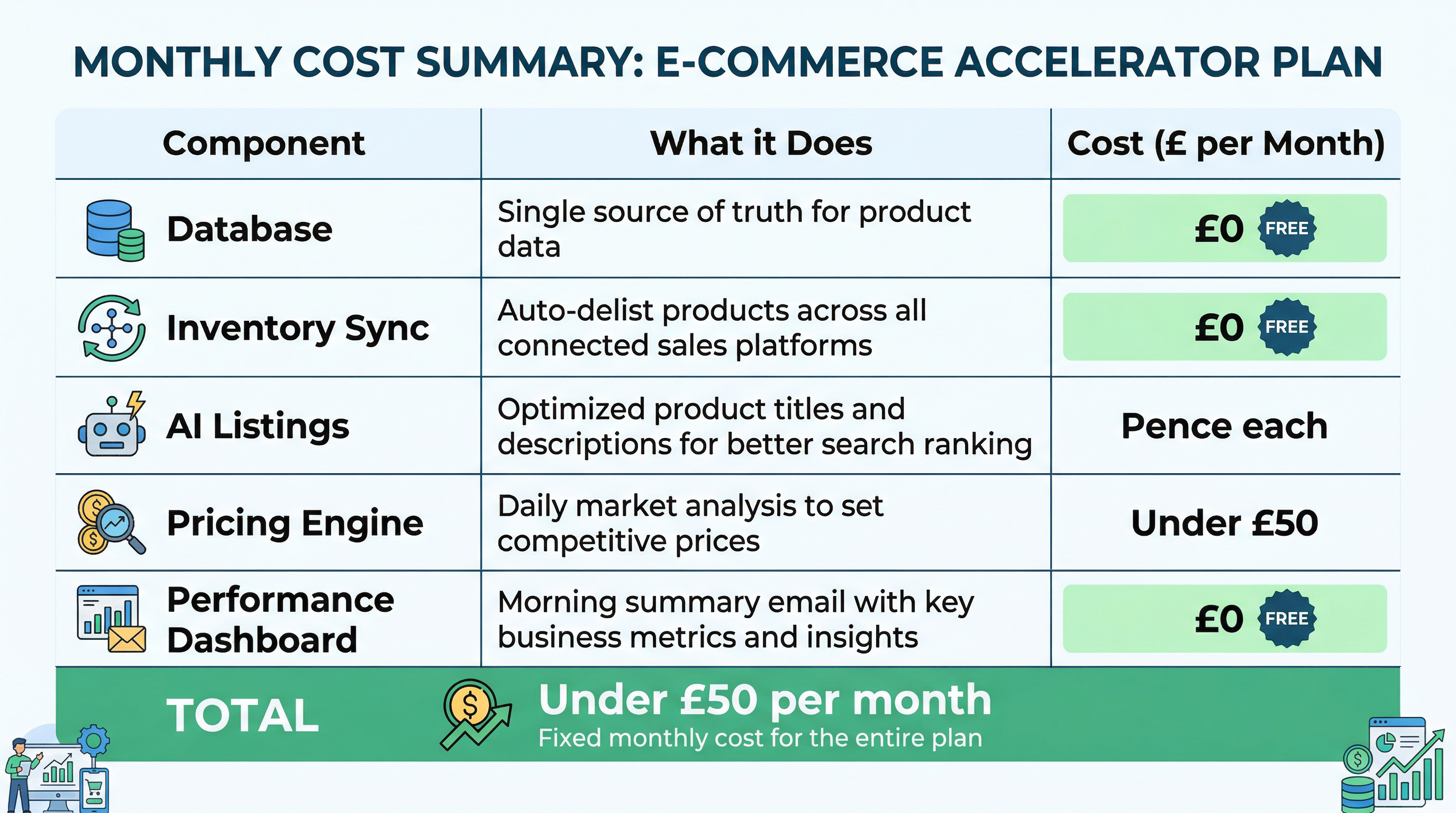
The two-layer cost model: free infrastructure underneath, low-cost AI intelligence on top.
| Component | What it does | Running cost |
|---|---|---|
| Centralised database | Single source of truth for all 650+ products | £0 (free tier) |
| Cross-platform sync | Auto-delist on sale across all 4 marketplaces | £0 (free tier) |
| AI listing generator | Platform-optimised titles, descriptions, pricing | Pence per listing |
| Pricing research engine | Daily sold-price analysis across full catalogue | Under £50/month |
| Performance dashboard | Morning email with sales, margins, and flagged items | £0 (free tier) |
| Margin calculator | True profit per item per platform after all fees | £0 (built in) |
| Dead stock alerts | Flags items with no activity after 90 days | £0 (built in) |
| Total monthly running cost | Under £50 |
The results
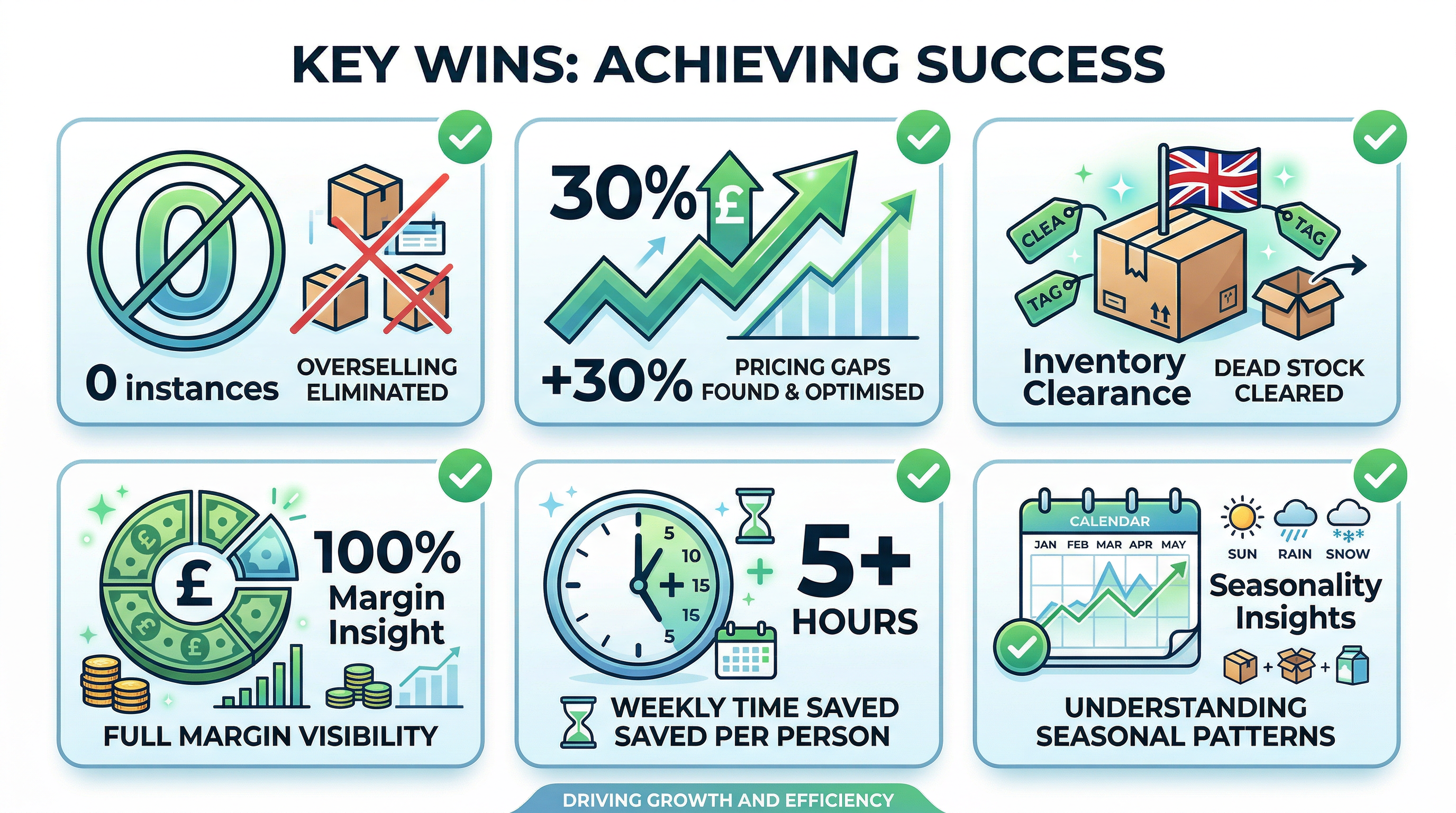
The key results: zero overselling, pricing insights worth more than the system cost, and 5+ hours saved per week.
Overselling: eliminated
Before the system, overselling was the single biggest operational risk. A few cancelled orders per month were considered normal. After implementing cross-platform auto-delisting, overselling dropped to zero. Seller metrics improved across all platforms, and the constant anxiety of "did I remember to delist that?" disappeared completely.
Pricing gaps worth more than the system cost
Within the first week of having structured pricing data across all platforms, the system revealed that one of the business's best-selling products was priced 30% below the average sold price on a competing platform. A single price correction on a single product recovered more value than the entire monthly running cost of the system.
This wasn't a one-off. The daily pricing analysis continues to surface opportunities — products where the market has moved and the listing price hasn't kept up.
Dead stock identified and cleared
The system flagged items that had been listed for over 90 days with no views and no interest. Some were overpriced for the current market. Some were listed on the wrong platform for their audience. Some were products that simply weren't in demand. Previously, these items sat quietly, tying up capital and storage space. Now they get flagged, repriced, moved to a better-suited platform, or cleared out — freeing up cash for better-performing stock.
Margin visibility across platforms
Each marketplace takes a different cut. eBay's fees differ from Amazon's, and BrickLink and Brick Owl each have their own commission structures. Shipping costs vary by platform too.
For the first time, the system showed true profit per item per platform, after all fees. This revealed that several products were breaking even on one platform while being profitable on another. The business didn't need to sell less — it needed to sell smarter, prioritising the platforms where each product actually makes money.
Seasonal patterns revealed
With months of structured sales data accumulating in the database, trends became visible for the first time. Certain LEGO themes spike predictably at certain times of year. Retired sets follow consistent appreciation curves. Minifigure demand shifts around film releases and cultural events.
Armed with this data, purchasing decisions moved from gut feel to evidence. Stock is now bought ahead of predicted demand rather than in reaction to it.
The technology
The system is built on Next.js (React framework) with Supabase (PostgreSQL database and authentication) as the backend. The database contains 45+ tables covering inventory, pricing snapshots, marketplace listings, order history, profit tracking, and more.
Marketplace integrations use the official APIs where available: eBay Browse and Sell APIs, Amazon SP-API, BrickLink API, and Brick Owl API. Where APIs are limited or unavailable, we've built custom data collection pipelines.
AI capabilities use large language model APIs for listing generation, description optimisation, and market analysis. The AI layer is model-agnostic — it works with whichever provider offers the best price-performance ratio at any given time.
Infrastructure runs on Google Cloud Platform (Cloud Functions, Cloud Scheduler) and Supabase's free tier (database, authentication, edge functions). The entire system is serverless — there are no servers to maintain, no patching, and no infrastructure management.
What Hadley Bricks says
"Before GainAI, I was spending hours every week updating spreadsheets and checking platforms. Now I spend that time sourcing stock and growing the business. The pricing insights alone paid for the system many times over — I had no idea I was leaving that much money on the table."
— Chris Hadley, Founder, Hadley Bricks
Could this work for your business?
Hadley Bricks runs 650+ products across four platforms, but the same principles apply at any scale. We've designed starter versions of this system for sellers with as few as 50 products on two platforms.
If you're selling across multiple marketplaces and managing inventory manually, you're spending time you don't need to spend and missing insights you can't afford to miss.
Request a free automation audit →
We'll look at your current setup, identify where you're losing time and money, and show you exactly what we could automate — with a clear breakdown of what it would cost and what you'd get back.