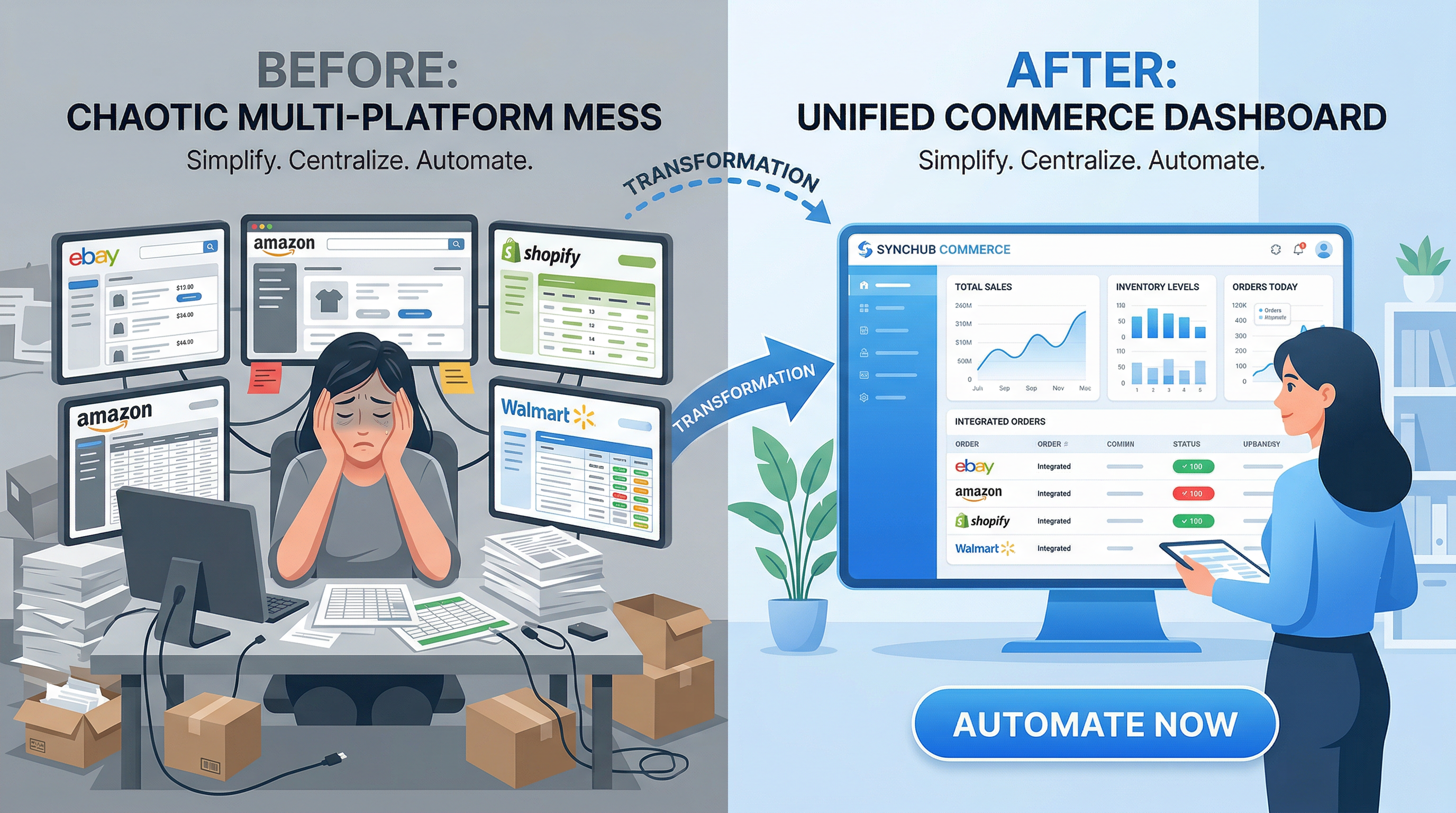
From juggling four separate dashboards to managing everything from a single screen. This is the transformation we built.
If you sell on more than one platform — eBay and Amazon, say, or Etsy and your own website — you already know the pain. Every sale means updating stock in two places. Every new listing means writing it twice. Every price change means logging into three different dashboards and hoping you don't forget one.
And the stakes are real. Sell something on eBay that's already gone on Amazon, and you're either cancelling an order (tanking your seller metrics) or scrambling to source a replacement. Marketplace algorithms are unforgiving — a few oversells can push your account into restricted territory.
This isn't a niche problem. Marketplaces now account for 45% of all UK eCommerce transactions, and that share is growing. For the thousands of small UK sellers making a living across these platforms, managing inventory manually isn't just tedious — it's a genuine business risk.
We recently helped a Kent-based eCommerce reseller automate their entire multi-platform operation. Here's what we built, what it cost, and — most surprisingly — what the data revealed once everything was connected.
The problem: four platforms, one spreadsheet, zero confidence
Our client sells specialist collectible products across four different marketplaces: eBay, Amazon, and two niche platforms specific to their industry. Over time, their catalogue had grown to more than 650 active items.
Their "system" was a spreadsheet. A big one. And it worked — up to a point. But as the product count grew, the cracks became impossible to ignore.
Items would sell on one platform and stay listed on another. Prices were set once and rarely reviewed, even as market values shifted. Listing descriptions were inconsistent — detailed on one platform, bare on another. And the owner was spending hours every week on admin that felt productive but wasn't actually growing the business.
Sound familiar? We hear this story from marketplace sellers every week. The spreadsheet was never supposed to become the backbone of the operation — it just happened gradually, and by the time it became a problem, everything depended on it.
They needed help. Not just a better spreadsheet, but a proper system — and someone to build it.
What we built: a single source of truth
The first thing we did was move all their inventory data into a proper database — a centralised system where every product, every price, and every stock level lives in one place. When something changes, it changes everywhere.
This sounds obvious, but it's the step most small sellers skip. They try to keep platforms in sync by updating each one manually, or they bolt another tool on top of their spreadsheet. Neither approach scales, and both create the gaps where overselling and pricing errors creep in.
Here's what the system does:
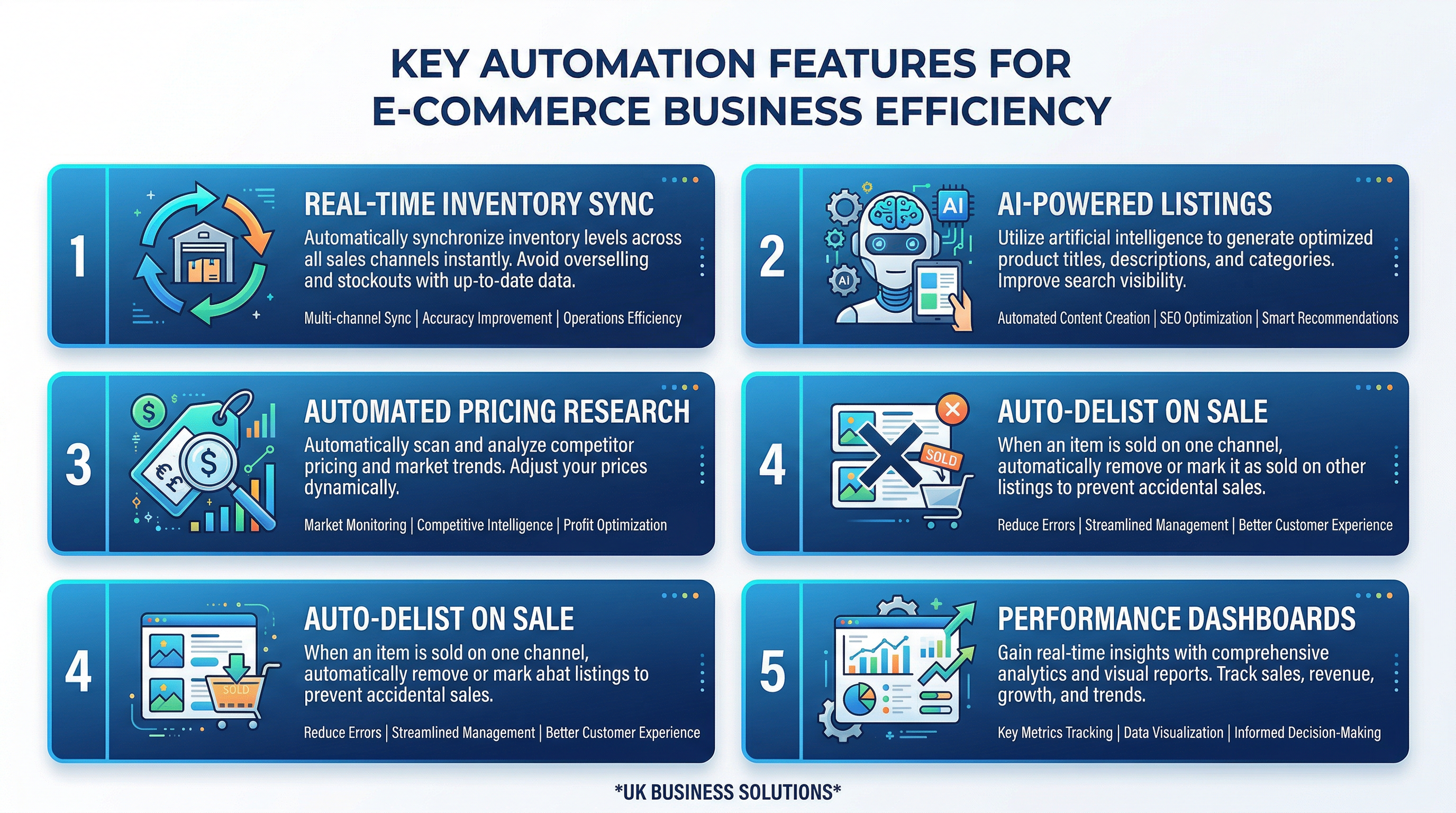
Five core features that took our client from spreadsheet chaos to automated control.
Centralised inventory with real-time sync. Every product has one record. When it sells on any platform, stock updates across all of them automatically. No more "did I delist that on eBay?" moments. The infrastructure to move data between platforms — API connections, scheduled jobs, webhook listeners — sits on free-tier cloud services. The plumbing costs nothing.
AI-powered listing creation. This is where the intelligence layer comes in. When a new product is added to the system, AI generates an optimised title, a detailed description, and pricing recommendations — tailored to each platform's requirements. eBay titles need different keyword strategies than Amazon listings. Niche platforms have their own conventions. The AI handles all of that, and the seller just reviews and approves. The cost? A few pence per listing.
Automated pricing research. Instead of guessing at prices, the system pulls sold-listing data from eBay — actual completed sales, not just what people are asking. It calculates average selling prices, price ranges, how quickly items sell, and what the demand looks like. The seller gets a clear recommendation: "price this at £X, it should sell within Y days." Previously, they were leaving money on the table on some items and overpricing others. Now every price is grounded in real market data.
Cross-platform delisting on sale. When an item sells anywhere, the system automatically removes it from every other platform. This single feature eliminated overselling entirely. Before, it was their biggest operational headache and the thing most likely to damage their seller ratings.
Performance dashboards. A daily summary drops into their inbox every morning: what sold yesterday, current stock levels, total profit margins across all platforms, and flagged items that need attention. No logging into four separate dashboards. No copying numbers into a spreadsheet. One email, every morning, before they've made their first cup of tea.
The cost: not what you'd expect
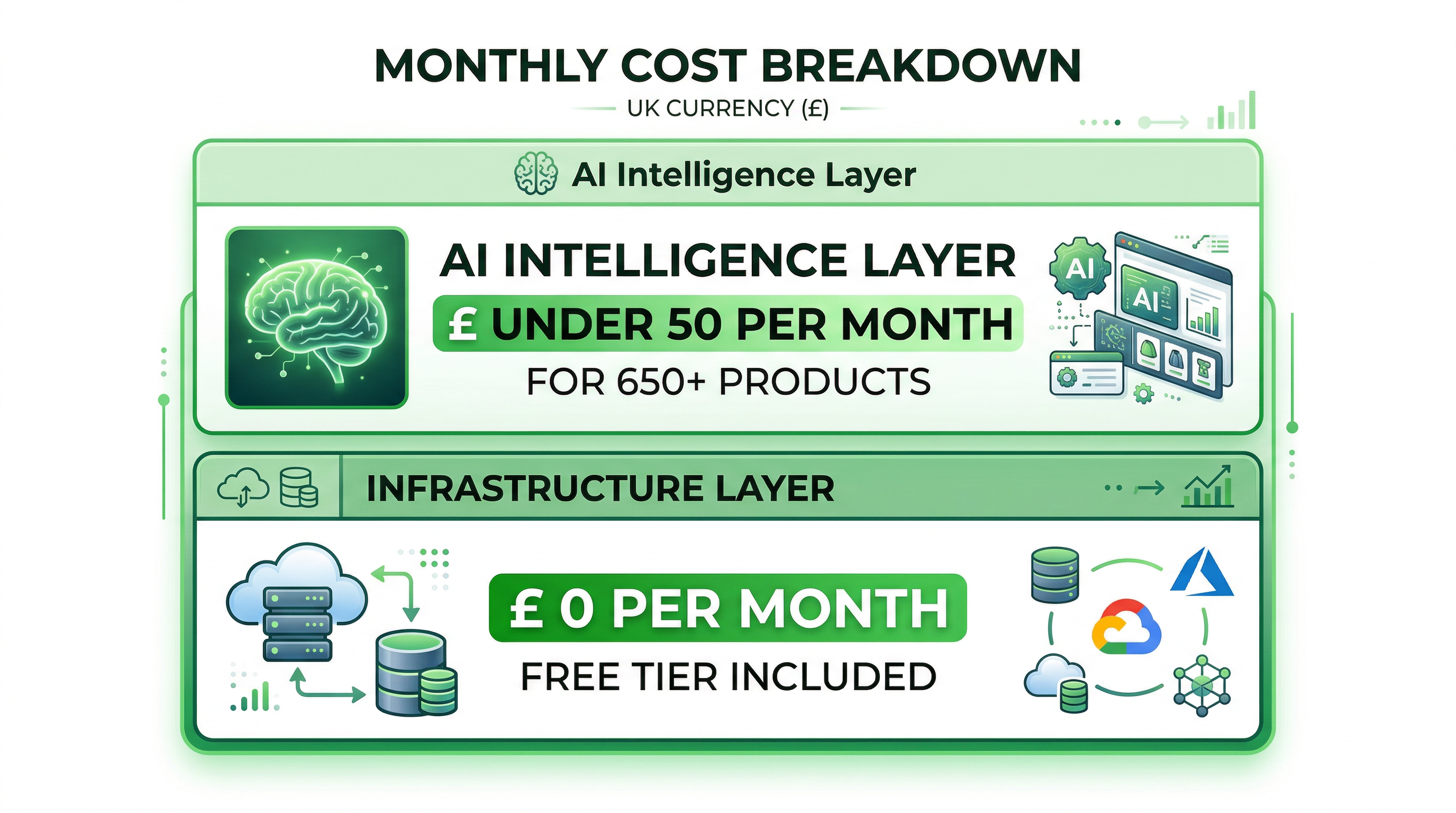
The two-layer cost model: free infrastructure underneath, low-cost AI intelligence on top.
Here's the breakdown of what this actually costs to run each month:
The infrastructure layer — the database, the API connections, the scheduled jobs, the webhook listeners, the daily reporting — runs entirely on free-tier cloud services. For a business with under a thousand products, the compute and storage requirements are minimal. Monthly cost: £0.
The AI layer — generating listing descriptions, analysing sold prices, drafting optimised titles — uses large language model API calls. Each product listing costs a few pence to generate. The daily pricing analysis across 650+ items comes in at under £5 per month. The intelligence layer is where the magic happens, but it's remarkably cheap for what it delivers.
Our service to design, build, and maintain the system is the main investment. But the return is immediate and measurable — which brings us to the most interesting part of this whole project.
The real surprise: what the data revealed
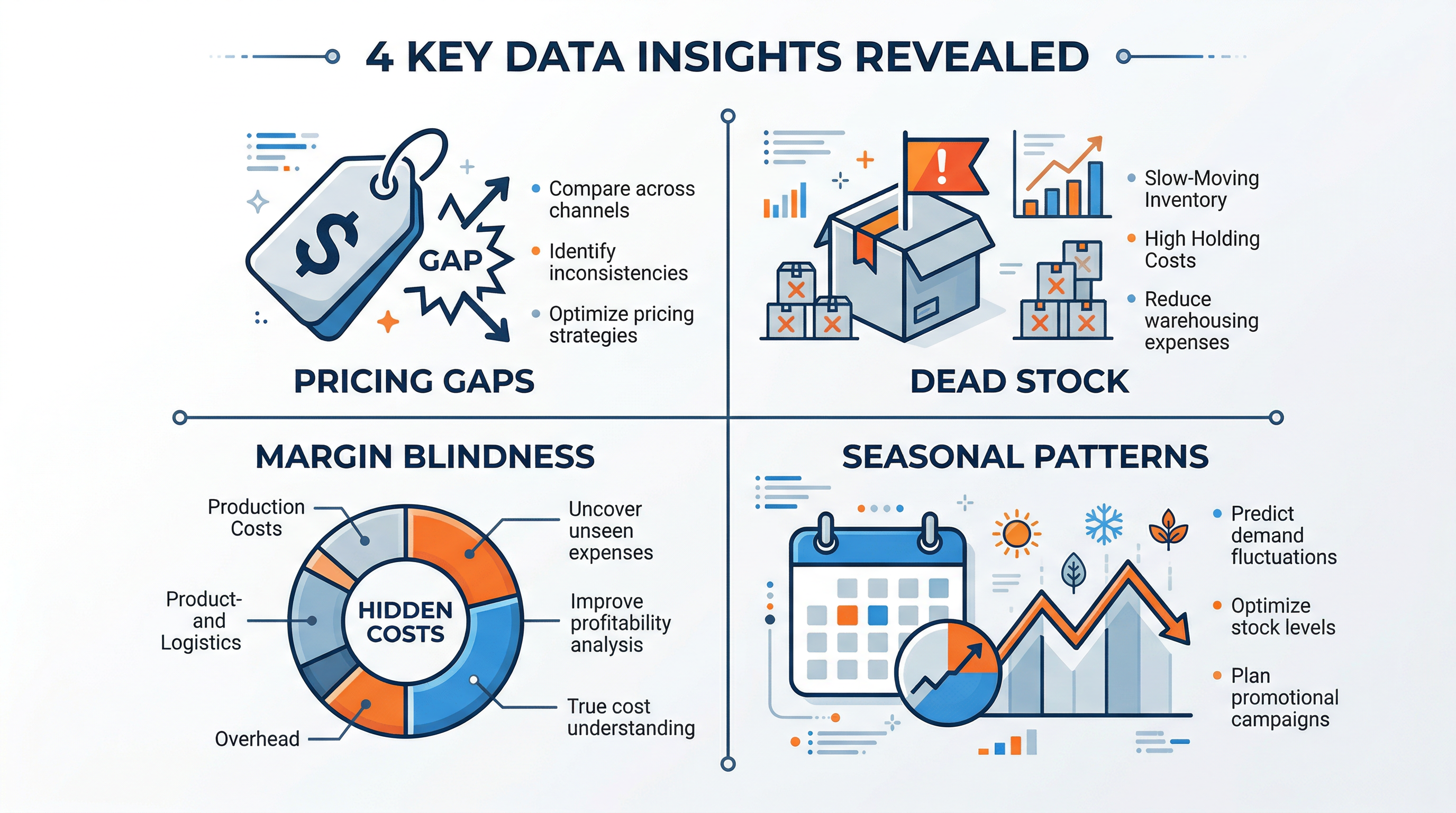
Once all the data flowed through one system, four insights emerged that our client had never been able to see before.
When we talk to small sellers about automation, they usually want two things: save time and stop overselling. Those are the obvious wins, and they happen straight away. But the real value — the thing that keeps surprising our clients — is what becomes visible once all your data flows through a single, consistent system.
Here's what our client discovered within the first few weeks:
Pricing gaps they couldn't see before. When every product's sold-price data sits alongside your actual listing price, patterns jump out. Our client found that their best-selling product on one platform was priced 30% lower than the average sold price on another. That single insight — invisible when data lived in separate tabs — was worth more than the entire cost of the system in a single week.
Dead stock they didn't realise they had. The system flagged items that had been listed for over 90 days with no views and no interest. Some were overpriced. Some were on the wrong platform. Some were simply products that nobody wanted. Previously, these sat there quietly consuming storage space and attention. Now they get flagged, repriced, moved, or cleared out — freeing up cash that was tied up in stock going nowhere.
Margin blindness across platforms. Each marketplace takes a different cut — eBay's fees differ from Amazon's, and niche platforms often have their own commission structures. When our client could finally see true profit per item per platform, they discovered that several products were actually losing money on one platform while being profitable on another. They weren't selling less — they started selling smarter.
Seasonal patterns they'd never tracked. With months of structured sales data accumulating, trends became obvious. Certain product categories spike predictably at certain times of year. Armed with this data, they now plan purchasing and pricing around seasonal demand instead of reacting to it. They went from gut feel to evidence-based decisions.
This is the compounding effect we talk about with every client. Automation starts by saving you time. Then it stops you making costly mistakes. Then it starts revealing opportunities you never knew existed. And over time, as the data builds, your business decisions get sharper and sharper — because they're based on real evidence, not instinct.
None of this is possible when your data lives in four separate dashboards and a spreadsheet that's two updates behind.
Why this matters for any multi-platform seller
You don't need 650 products to feel this pain. We've spoken to sellers with 50 items across two platforms who are already drowning in manual updates. The threshold isn't about volume — it's about complexity. The moment you're selling the same product on more than one platform, you have a synchronisation problem. And that problem only gets worse as you grow.
The multi-channel selling landscape is also getting more competitive, not less. With rising costs squeezing margins across the UK economy, the sellers who thrive in 2026 will be the ones who know their numbers — who can tell you their true margin per item per platform, who can spot a pricing opportunity before their competitors do, and who aren't wasting hours every week on admin that a system could handle.
The tools to build these systems exist. The cloud infrastructure is free. The AI is cheap. But knowing how to connect it all — which APIs to use, how to handle edge cases, how to make it reliable enough that you can trust it and forget about it — that's the expertise that matters.
That's what we do.
What this looks like for a smaller seller
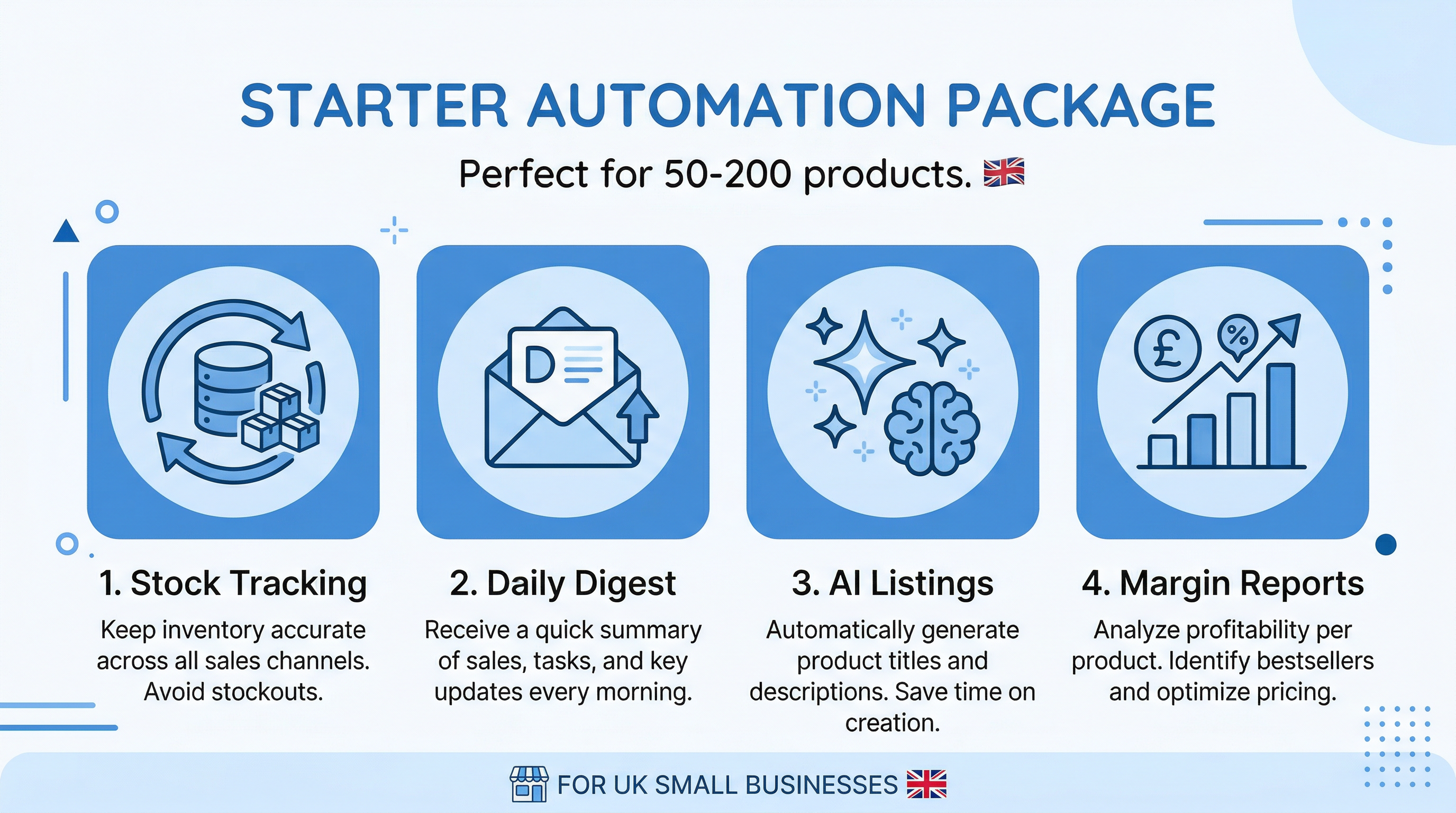
You don't need 650 products to benefit. Our starter package covers the essentials for smaller sellers.
Not every seller needs a 650-product, four-marketplace system. If you're running a smaller operation, the principles are the same — just scaled down. Here's what a typical starter automation looks like for a seller with 50-200 products across two platforms:
Centralised stock tracking — one database that both platforms draw from. When something sells, it's delisted everywhere. No more overselling.
Daily sales digest — a morning email showing yesterday's sales, current stock levels, and anything that needs your attention. Five minutes of reading instead of 30 minutes of dashboard-hopping.
AI-assisted listings — when you add a new product, the system generates a draft listing optimised for each platform. You review, tweak if needed, and publish. What used to take 20 minutes per listing now takes two.
Monthly margin report — a clear view of your actual profit per item, per platform, after fees. No more guessing whether you're making money.
The infrastructure for this runs on free-tier cloud services. The AI layer adds a few pounds a month. We handle the design, build, and ongoing maintenance — and the whole thing pays for itself within weeks through time saved and pricing improvements.
Ready to get your platforms talking to each other?
If you're selling across multiple marketplaces and still managing inventory manually, you're spending time you don't need to spend and missing insights you can't afford to miss.
We offer a free 30-minute automation audit where we look at your current setup, identify where you're losing time and money, and show you exactly what we could automate — with a clear breakdown of what it would cost and what you'd get back. We work with sellers of all sizes, from 50 products on two platforms to 1,000+ across five.
Request your free automation audit →